Try current-format TOEFL 2026 tasks
Start with short drills from Reading, Listening, Speaking, and Writing so the new format feels familiar before a full test.
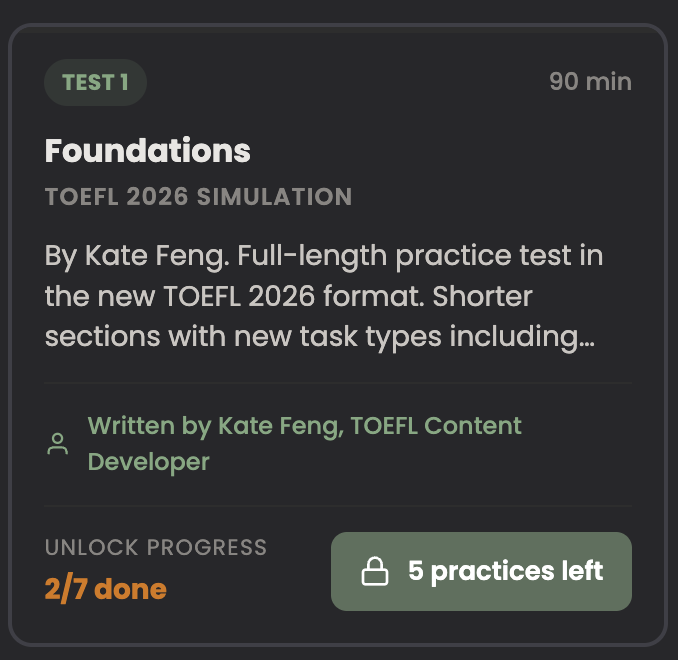
Start free, unlock your first baseline test after 7 attempts, and avoid wasting your first full mock test cold. Learn the new task types first, then get a more useful full baseline test with AI feedback for speaking and writing.
Most students want a full mock test immediately. PrepEx makes the unlock path a prominent pedagogical decision: learn the 2026 task types first, then use your baseline result to make better study decisions.
Your first full TOEFL 2026 practice test unlocks after 7 practice attempts. That progression helps you avoid a noisy cold score and gives you a better starting point for targeted prep.
Start with short drills from Reading, Listening, Speaking, and Writing so the new format feels familiar before a full test.
Build momentum with fast reps. PrepEx uses this path deliberately so your first baseline reflects readiness, not confusion about the new format.
Take the TOEFL 2026 practice test after a warmup, with the current task mix and realistic timing visible before you begin.
Turn the baseline into a study plan: drill the section that is holding you back instead of repeating random mock tests.
A cold mock test can tell you that you are unfamiliar with the interface. A short progression tells you what to study next.
TOEFL 2026 added task families many students have never practiced. PrepEx uses 7 short attempts as a warmup before the first full test, so the score report is easier to trust and easier to act on.
Build a Sentence is one of the short TOEFL 2026 tasks that helps students practice grammar, word order, and response speed before a full test.
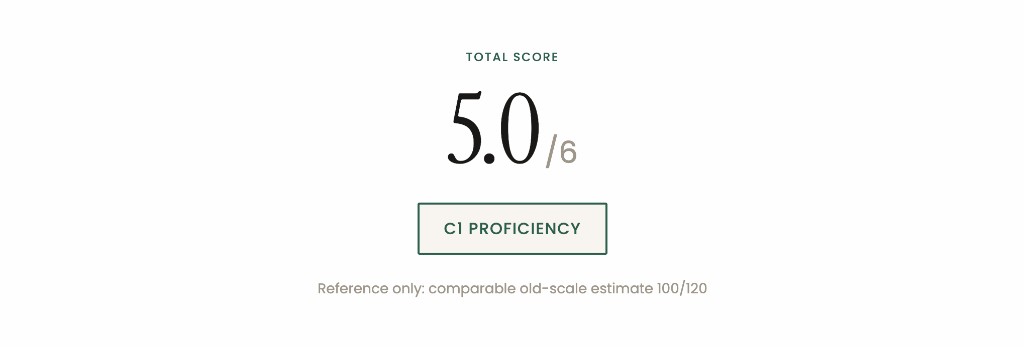
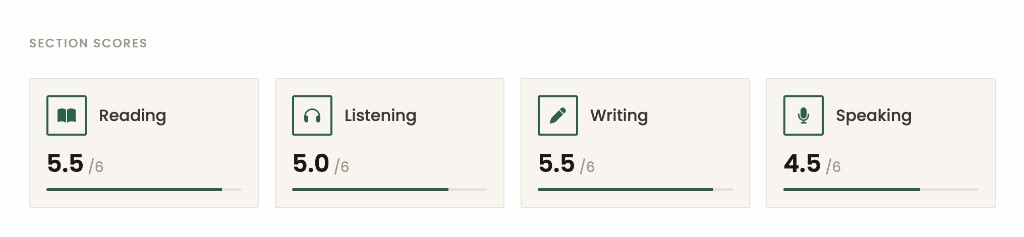
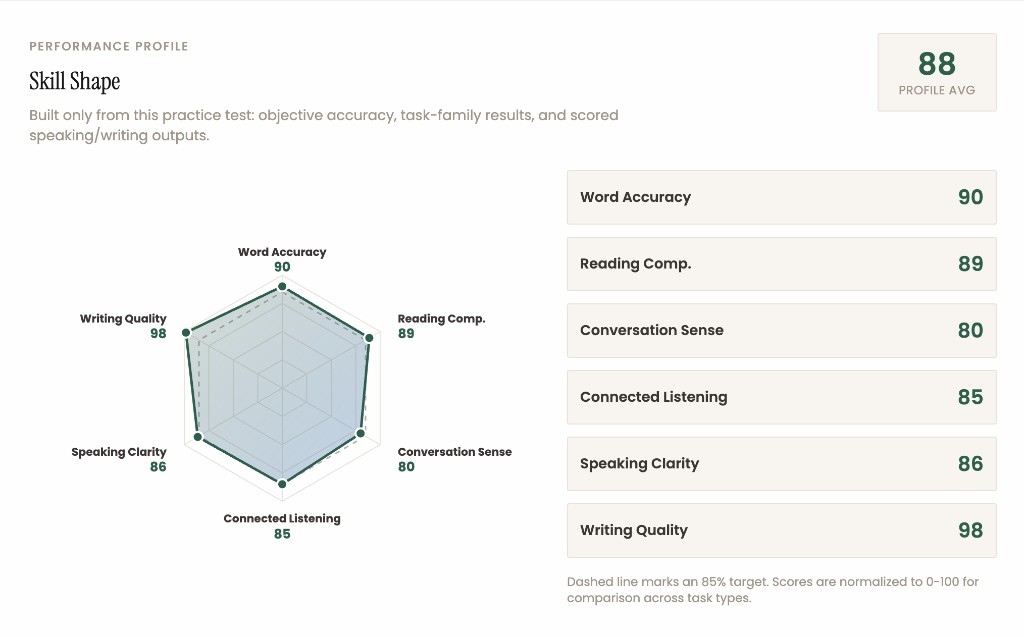
After the 7-attempt unlock path, your baseline test follows the current TOEFL 2026 structure below.
Free TOEFL mock tests can be useful, but many drop you into a full test before you understand the current task types. PrepEx starts with short drills so the baseline has context.
| What to check | Typical free TOEFL mock test | PrepEx 7-drill baseline path |
|---|---|---|
| First action | Starts the full mock test immediately, often with little task preview. | Starts with a free TOEFL 2026 practice path, then unlocks the first baseline after 7 attempts. |
| Task coverage | Only broad section names, no visible task families. | Shows all 12 TOEFL 2026 task types before the test begins. |
| Timing | Still framed as the older 2-hour four-task experience. | Reflects the current ETS item counts, base timing, and adaptive Reading/Listening sections. |
| Speaking format | Generic speaking practice only. | Includes Listen and Repeat plus Take an Interview preparation. |
| Writing format | Essay-only or unclear writing scope. | Includes Build a Sentence, Write an Email, and Write for an Academic Discussion. |
| Feedback loop | Only a raw score or no speaking/writing analysis. | Combines full-test benchmarking with speaking and writing feedback. |
| Baseline quality | Drops students into a cold mock test before they understand the format. | Uses short drills first so the first baseline is easier to interpret. |
| Credibility | Little information about who built the content. | Points to the content team, advisors, and outcomes data. |
Full tests matter most when they feed your next study decisions. PrepEx turns the first test into a progression: warm up, unlock the baseline, then repair weak sections.
You do a few short attempts first, so your first full TOEFL 2026 practice test is not just a cold score with no context.
PrepEx is especially useful when your weaker sections are productive ones, because speaking and writing are tied to AI analysis and guidance.
The page and product both show the current TOEFL 2026 blueprint clearly, which helps you avoid practicing old-format behaviors.
Every practice test, passage, and question is written by our content team — language teachers, curriculum designers, and test prep specialists with decades of combined experience. Content is reviewed by our advisory board for accuracy and alignment with actual TOEFL 2026 standards.
Industry leaders guiding PrepEx's development of world-class TOEFL preparation
Real numbers from students using PrepEx practice tests and feedback tools.
That figure comes from the State of Learning at PrepEx snapshot, alongside documented score lifts above 35% after repeated PrepEx practice.
Students do not improve because they only take more mock tests. They improve when full tests show what to target next.
Speaking and writing are hard to improve without feedback. Our AI analysis gives you score predictions and specific next steps after every response.
"I went from 81 to 106 in two months. The AI grading pointed out things I didn't even realize I was doing wrong. Petra helped me stop memorizing and just sound more natural."

"I practiced for seven weeks straight and still didn't run out of new questions. PrepEx helped me reach my target score."
"Honestly the grading is so close to the real thing. When I got my scores I couldn't believe it. I got so much valuable feedback from PrepEx on every practice."

Try one AI-scored TOEFL 2026 speaking prompt before your baseline test.
Try one of the new TOEFL 2026 writing task types before your baseline test.
Try one practical TOEFL 2026 email task with an AI score preview.
Warm up on TOEFL 2026 reading vocabulary-in-context before the full test.
Quickly verify whether a platform is actually ready for the new TOEFL format.
Use a final-week cram plan to unlock a baseline, find score leaks, and drill only what matters.
Compare full platforms, official resources, tutors, and study styles.
See where AI is genuinely helpful and where it is mostly noise.
Complete 7 short attempts, unlock your first full baseline practice test, then use the result to decide exactly what to practice next. That is a better first test than a cold mock with no context.